Legal Remedies and Insurance Coverage for Property Damage by Third Parties in Malta
What legal remedies are available to property owners when third parties cause damage to their property?
Does insurance typically cover such damages?
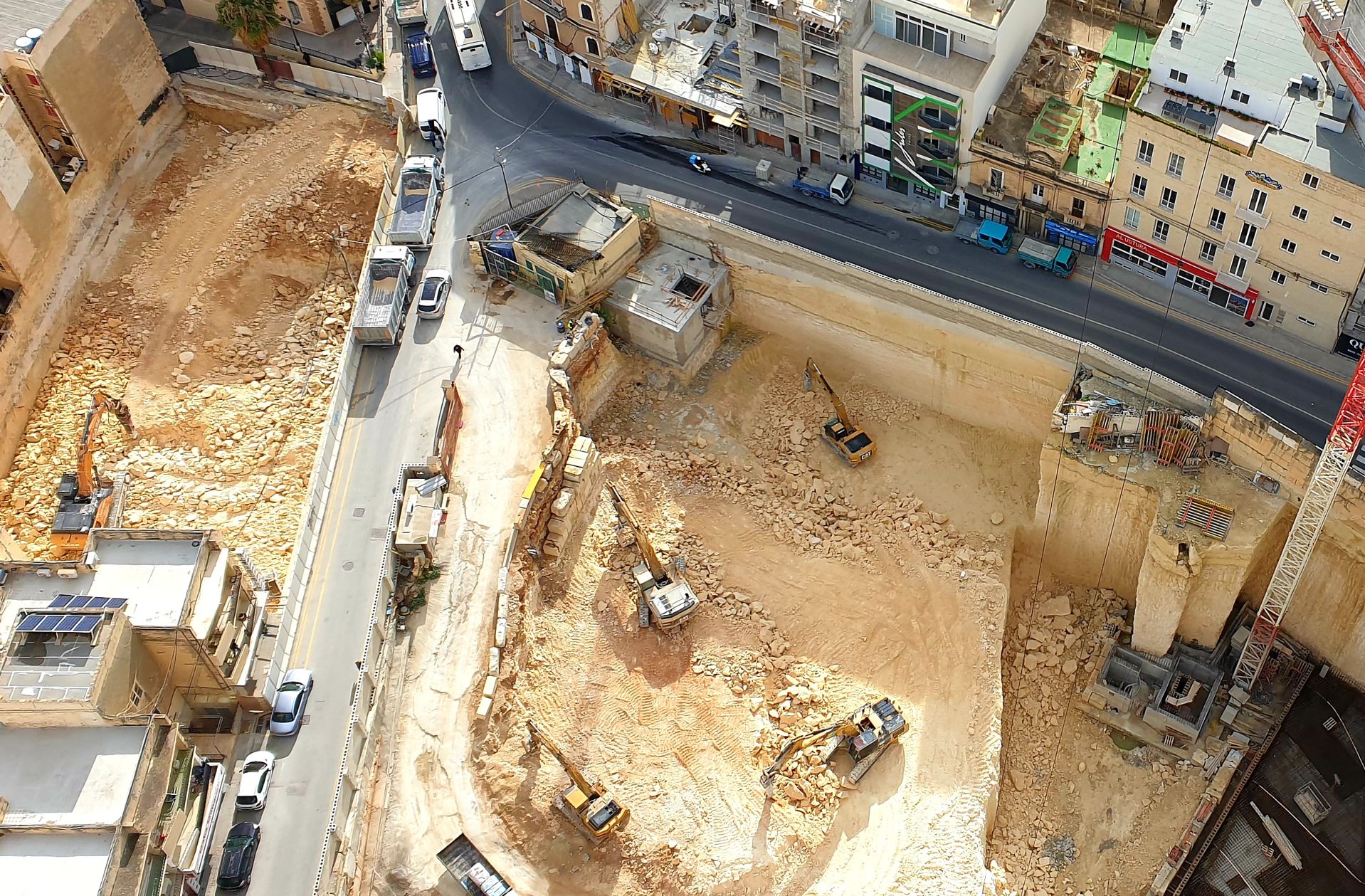
In Maltese property law, owners have specific legal remedies which they can resort to, when third parties cause damages to their property, particularly during construction or demolition works. The Avoidance of Damage to Third Party Property Regulations, Subsidiary Legislation 623.06, governs situations where construction projects may affect adjacent properties, requiring developers to adhere to measures designed to prevent and manage damage. These Regulations are made applicable to any construction work involving one or more of the following:
- Any excavation impacting the surrounding area of third-party property
- The demolition of any existing structures which are contiguous to or occupied by third parties
- The building of additional storeys or load-bearing walls or structures over any property which belongs to or is occupied by third parties
- The construction of new buildings or additional storeys adjacent to existing third-party property.
When it comes to insurance, also in terms of the Avoidance of Damage to Third Party Property Regulations, developers, when applying for a permit must secure an insurance cover of a minimum of €750,000 and must be renewed until the work is completed. A copy of the insurance copy must be sent to the Director of the Building Regulation Office (BRO). Secondly, a bank guarantee, the value of which cannot exceed €40,000 must also be provided.
Nonetheless, this may not be required if the developer has submitted a certified statement issued by an insurance company stating that the developer is also insured to cover indemnity for damages to third parties.
When it comes to building on adjacent property, the developer must prepare a condition report on the opposite, underlying and overlying third party property, which a copy of it must be sent to third parties at least 2 weeks prior to the commencement of the work. In case of excavation the condition report must also contain within it the properties which fall within the affected zone of excavation. The condition report must specify how loads are to be transmitted to the foundations, identifying the type and dimensions of foundations within the designated zone and estimating the bearing pressure found at foundation level for strip footings, pat footings and raft foundations.
If the owners of the adjacent or nearby property, who would have received a copy of the report encounter any problems or disagree with anything which is contained therein, they should give notice to the Director of the BRO within 2 weeks. Otherwise, the report would have been deemed to be accepted. When a notice is indeed given, still, the architect can consult with the third parties to issue a second report. If there is still no agreement, then the Director can order an inspection.
Nonetheless, if the architect in charge of the project certifies that the construction works will not affect third party property, the developer need not do an insurance cover, a bank guarantee, a method statement and a condition report, and a site technical officer would not need to be appointed. However, if these documents are required, these must be made available online, allowing third parties to raise objections to the proposed activities.
A person violating these regulations can be subject to either criminal proceedings or else to an administrative penalty. These regulations are made applicable to works which have started but were not complete by the 25th of June 2019 and also to those construction works which are yet to start.
Other safeguards are put in place to ensure that third-party damage is avoided. Under the Avoidance of Damage to Third Party Property Regulations, the architect is responsible for ensuring that the contractor fulfils his obligations. A licenced ‘perit’ must also fulfil the role of a site technical officer in cases of demolition and excavation projects. Nonetheless, sometimes, this role can also be filled by the same architect who is overseeing the project.
The architect in charge is also vested with professional responsibility when it comes to the method statement. Through the 2019 amendments, it is obligatory to specify, in the method statement the starting point of the excavation, any required phasing for achieving necessary rock buttressing, the permitted and prohibited machinery equipment and the type and location of the crane which is used. Whilst the architect will retain the ultimate responsibility for the method statement, its enforcement lies with the site technical officer and implementation lies with the contractor. This method statement must also be submitted within a minimum of 2 weeks before the commencement of the work. If any interested third party wishes for the Director to review this statement, a detailed report must be submitted by an architect indicating the technical reasons for review.
Today, it is the duty of the site technical officer to consult with the architect in charge of the project if procedural uncertainties. The site technical officer also has a duty to report to the architect and to the BRO of any violations by the contractor.
If the director of the BRO feels that there is no adherence to the above regulations, he may issue an enforcement notice to halt the commencement of the work. Thereafter, this shall be communicated with the architect and contractor so that the order is complied with. The director also has the power to issue interim measures and impose administrative penalties for infringement of any provision.
If works have commenced and the neighbours note that the construction is not being done in accordance with the method statement, then, they can report to the Building and Construction Authority (BCA) and file for a warrant of prohibitory injunction. A lawsuit for damages can also be filed in accordance with Clause 20(2) of the above-mentioned regulations which directs third parties suffering damages to refer the case to arbitration. Therefore, if the damages incurred by third parties do not impair the stability of the property or endanger its inhabitants, or else, if the cost of damages does not exceed €1 million, then, the case must be referred to arbitration. Then, if the claim does refer to damages which do exceed €1 million or which endanger the inhabitants, the matter is to be referred to the ordinary courts.
Our team of property law experts at Sciberras Advocates in Malta is here to assist with any legal issues you may encounter. Feel free to reach out to us at [email protected] for professional support.
This article is for information purposes only and should not be construed as legal advice.
Article and research done by Ms Caitlin Turner, LL.B. (Hons) (Melit.), currently reading a Master of Advocacy at University of Malta.
Sciberras Advocates founded by Dr Adrian Sciberras, is a law firm based in Malta. The firm prides itself to be multi-disciplinary, innovative and flexible in order to meet the changing times and any challenges in the local and international legal scenario. No matter what private or corporate complex demands are called for, Sciberras Advocates offers practical and cost-effective legal solutions to achieve your desired results. You may reach Sciberras Advocates by phone on +35627795222 or via email on [email protected].
Article originally published here: https://sciberras.legal/2025/01/09/remedies-for-property-damage-by-third-parties/